The email verifier
you can trust
Supercharge your inbox success with 99% accurate, real-time email validation. Maximize open rates and reach your audience effortlessly!
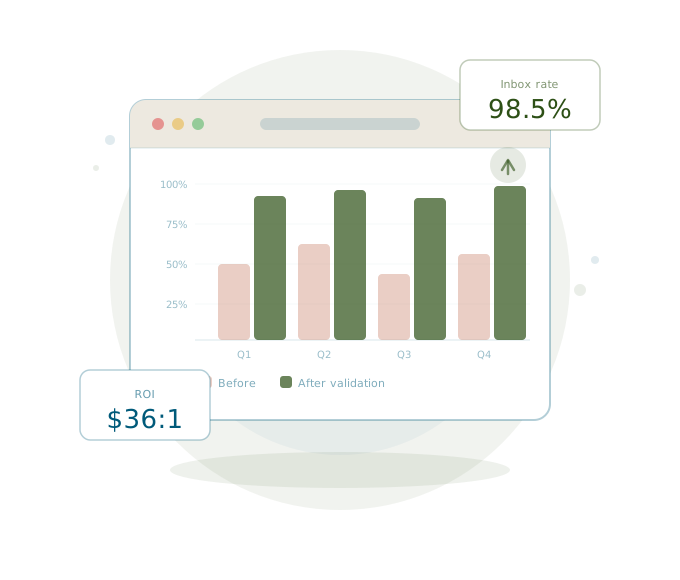
Poor email list hygiene is the leading cause of low inbox placement. According to Campaign Monitor, a bounce rate above 2% can damage your sender reputation, yet without regular email validation, lists can accumulate 22–25% invalid addresses per year. Every invalid or risky address you send to harms your sender reputation and can push your emails straight to the spam folder.
BounceShield's email checker removes harmful addresses before they cause problems, keeping your sender score healthy and your campaigns performing at their best. With email marketing delivering an average ROI of $36 for every $1 spent (Litmus), protecting your deliverability directly protects your revenue.
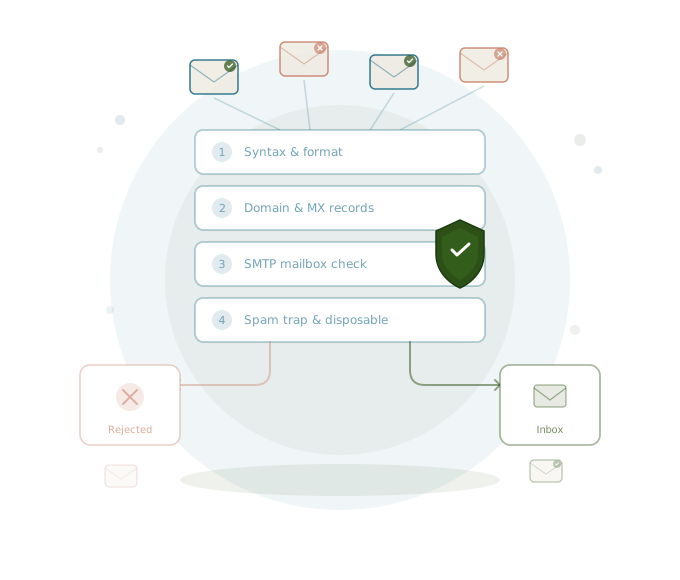
Start for freeBounceShield's multi-layer email validation ensures your messages reach real inboxes. According to Validity's email deliverability research, roughly one in six marketing emails fails to reach the inbox, with poor list hygiene being a primary cause. Our verification engine complements your SPF, DKIM, and DMARC configuration by ensuring you only send to addresses that exist and are able to receive mail.
| Step | What We Check | What It Catches |
|---|---|---|
| 1. Syntax Validation | Email format against RFC 5321/5322 standards | Typos, missing @ symbols, invalid characters |
| 2. Domain & DNS Check | Domain exists and resolves to valid DNS records | Non-existent or parked domains |
| 3. MX Record Lookup | Mail exchange records configured to accept email | Domains with no mail server |
| 4. SMTP Verification | Mailbox exists via SMTP handshake with the MTA | Non-existent mailboxes, hard bounces |
| 5. Disposable Detection | Address matched against known disposable email providers | Temporary or throwaway addresses |
| 6. Catch-All Flagging | Domain accepts all addresses regardless of mailbox | Unverifiable catch-all domains |
| 7. Risk Screening | Spam traps, role-based addresses, greylisting patterns | Spam traps, info@/admin@ addresses, abuse risks |
You can use your email verification credits for single email checks, bulk email verification, verifying lists imported from your ESP, and through our email verifier API. Credits never expire, giving you the flexibility to use them whenever you need.
BounceShield works seamlessly with your existing email marketing platform and is compatible with all providers.


Sending campaigns to unverified lists is one of the most expensive mistakes in email marketing. According to Validity's 2025 Email Deliverability Benchmark Report, one in every six marketing emails worldwide fails to reach the inbox. The primary causes are poor list hygiene, high bounce rates, and low sender reputation scores.
The global email marketing market is projected to surpass $17.9 billion by 2027 (Statista), yet that one-in-six failure rate means businesses routinely lose a significant share of their email spend on messages that never reach a human inbox. Regular email list cleaning eliminates this waste by removing hard bounces, spam traps, disposable addresses, and inactive mailboxes before they damage your sending infrastructure.
BounceShield's verification engine analyzes each address through seven distinct checks: syntax and formatting against RFC 5321 and RFC 5322 standards, DNS resolution, MX record validation, SMTP handshake with the destination MTA, disposable domain matching, catch-all flagging, and risk screening for spam traps, role-based addresses, and greylisting patterns. This multi-step process identifies deliverability risks that simpler email checkers miss.
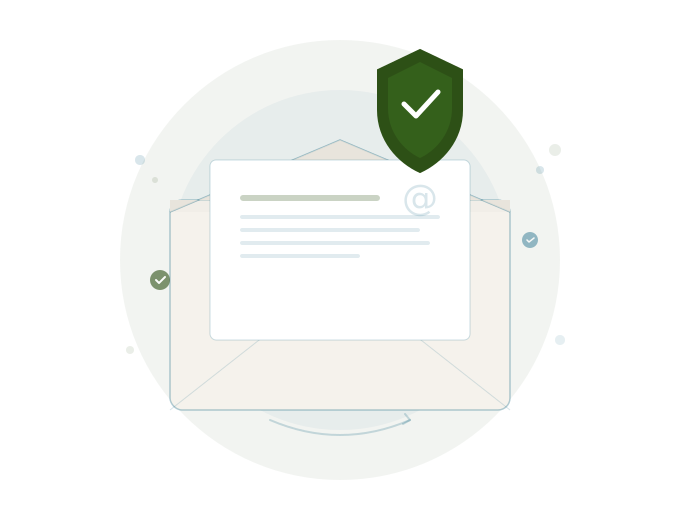
An email verifier is a tool that checks whether an email address is valid, active, and capable of receiving messages. It works by running a series of checks (syntax validation, domain DNS resolution, MX record lookup, SMTP mailbox verification, and detection of disposable, role-based, and catch-all addresses) to determine whether an email will hard-bounce or successfully reach a real inbox before you press send.
Who needs email verification? Any team that depends on email reaching real people. Email marketers use an email verifier to clean subscriber lists before campaign sends, keeping bounce rates low and protecting sender reputation. E-commerce and SaaS platforms verify addresses at the point of sign-up to block fake accounts, reduce fraud, and ensure transactional emails like order confirmations and password resets reach genuine customers. Sales teams run outbound contact databases through an email checker to remove dead leads before launching sequences, improving reply rates and avoiding domain blacklisting.
When should you verify? The short answer: before every campaign send and whenever your list changes. Run a bulk verification pass before each email campaign to catch addresses that have gone stale since your last send. Schedule a quarterly clean of your full subscriber list to remove contacts that have changed jobs, abandoned mailboxes, or converted to catch-all domains. Verify at the point of capture (sign-up forms, checkout flows, lead magnets) using a real-time verification API to stop bad data from entering your system in the first place. And always verify after importing or purchasing a new contact list, since third-party data is especially prone to invalid and disposable addresses.
For a comprehensive walkthrough of the entire process, read our complete email verification guide. To understand why list hygiene matters, see why you should verify your email lists. If your lists are already degrading, learn how to stop email list decay. For hands-on instructions, follow our step-by-step email list cleaning guide, or compare the best email verifiers in 2026 to find the right tool. You can also browse our support page for quick answers or explore flexible pricing starting at just $0.0019 per verification.
Understand how email verification works, how to choose the right tool, and why it pays for itself.
The terms email verification and email validation are often used interchangeably, but they serve distinct purposes in the email hygiene process. Validation checks the format and syntax of an address against technical standards like RFC 5322, ensuring the address is structurally correct before it enters your database. Verification goes further: it communicates with the destination mail server via SMTP to confirm the mailbox exists and can accept messages.
A comprehensive email checker like BounceShield performs both steps automatically. The verification engine also screens for disposable domains, catch-all configurations, spam traps, and role-based addresses (e.g., info@ or admin@). This multi-layer approach, sometimes called email scrubbing, is what separates surface-level syntax checks from true deliverability testing that protects your sender score and improves inbox placement.
Not all email verification services are created equal. When evaluating an email verifier, look beyond headline accuracy claims and consider verification depth: does the tool perform SMTP-level checks, or does it stop at syntax and domain validation? A thorough verifier should detect disposable emails, catch-all domains, spam traps, and role-based addresses in addition to confirming mailbox existence.
Pricing models matter too. Some providers lock you into monthly subscriptions regardless of volume, while pay-as-you-go models like BounceShield let you buy credits that never expire, ideal for businesses with variable sending volumes. Also evaluate integration options: can the verifier connect to your existing ESP (Mailchimp, HubSpot, ActiveCampaign), and does it offer a real-time API for point-of-capture validation on sign-up forms?
Free email verification tools typically check syntax and domain formatting only, the equivalent of confirming an address looks correct. They skip the SMTP handshake that confirms the mailbox exists, miss disposable and catch-all domains entirely, and cannot detect spam traps or role-based addresses. The result: your list still contains addresses that will hard-bounce, damage your sender reputation, and inflate ESP costs. Free tools are useful for a quick spot-check, but they leave the most damaging address types untouched.
Paid email verifiers like BounceShield add the layers that free tools lack: real SMTP mailbox confirmation, disposable domain screening, catch-all flagging, and spam trap detection. But pricing models vary widely across providers. Subscription-based verifiers charge monthly whether you use them or not, which is expensive for businesses that verify seasonally or before occasional campaigns. Pay-as-you-go models let you buy credits only when you need them, with no recurring fees eating into your budget between sends.
A quick cost example: Say you maintain a 50,000-contact email list. Industry data shows roughly 22% of those addresses go invalid each year. That is 11,000 contacts sitting in your ESP, costing you per-contact platform fees and dragging down your deliverability metrics. Cleaning that list with BounceShield costs $69 for 50,000 credits (just $0.00138 per email at that tier). Compare that to the compounding cost of higher bounce rates, lower inbox placement, and inflated ESP bills month after month. One verification pass typically pays for itself within a single campaign send.
Everything you need to know about email verifiers, email validation, and how BounceShield helps protect your sender reputation.
An email verifier is a tool that checks whether an email address is valid, active, and able to receive messages. It runs multiple checks including syntax validation, domain and MX record lookup, SMTP mailbox verification, and disposable email detection to determine deliverability before you send.
Email verification works in multiple layers: first it checks the email format against RFC 5321 standards, then it verifies the domain has valid DNS and MX records, next it connects to the mail server via SMTP to confirm the mailbox exists, and finally it screens for disposable, role-based, and spam-trap addresses.
Email verification confirms that a specific mailbox exists and can receive messages by communicating with the mail server via SMTP. Email validation checks the format and structure of an address against technical standards like RFC 5322. In practice, most email verifier tools, including BounceShield, perform both as part of a single process.
BounceShield offers pay-as-you-go email verification starting at $19 for 10,000 credits ($0.0019 per email). Larger packages go up to 2,000,000 credits for $599 ($0.0003 per email). Credits never expire, there are no monthly fees, and every account gets 100 free credits to start. See our full pricing.
Yes. Email marketing delivers an average ROI of $36 for every $1 spent (Litmus), but only if your messages reach the inbox. Without verification, email lists degrade by 22–25% per year, leading to higher bounce rates, lower sender reputation, and wasted marketing budget. Even small lists benefit from regular cleaning.
BounceShield accepts CSV, TXT, and Excel file uploads for bulk email list verification. You can also import contacts directly from integrated email marketing platforms like Mailchimp, HubSpot, and ActiveCampaign, or use the BounceShield API for programmatic verification.
BounceShield delivers up to 99% verification accuracy through its multi-layer process: syntax checks, DNS and MX record validation, SMTP mailbox confirmation, and detection of disposable, catch-all, and spam-trap addresses. Single emails are verified in 1–3 seconds; bulk lists process at approximately 100,000 emails per hour.
Yes. Every BounceShield account receives 100 free email verification credits with no credit card required. You can use these credits for single email checks, bulk list verification, or API calls. When you need more, credit packages start at $19 for 10,000 verifications and never expire.
Industry best practice is to verify your email list at least once per quarter. According to ZeroBounce research, email lists lose roughly 22–25% of valid contacts each year due to job changes, abandoned accounts, and provider shutdowns. High-volume senders or businesses running weekly campaigns should verify monthly to maintain optimal deliverability.
A catch-all (or accept-all) email address is configured on a domain to accept messages sent to any address at that domain, whether or not a matching mailbox exists. This makes it impossible to confirm via SMTP whether a specific recipient is real. BounceShield flags catch-all domains so you can decide how to handle them based on your own risk tolerance.
Sending to an invalid address triggers a hard bounce: the receiving server permanently rejects the message. According to Campaign Monitor, a bounce rate above 2% can damage your sender reputation with ISPs like Gmail, Outlook, and Yahoo. Repeated hard bounces may cause your domain or IP to be blocklisted, sending all future emails to spam.
Yes. BounceShield provides a RESTful email verification API that returns real-time results in JSON format. You can integrate it into sign-up forms, CRM workflows, or custom applications to verify addresses at the point of capture. The API uses the same multi-layer checks as the dashboard: syntax, DNS, MX, SMTP, and disposable detection.
A good email bounce rate is below 2%. According to Campaign Monitor, anything above 2% signals list hygiene problems and may trigger ISP penalties. Regular email verification with a tool like BounceShield helps keep your bounce rate well under this threshold.
Look for verification depth (SMTP-level checks, not just syntax), disposable and catch-all detection, spam trap filtering, and bulk list support. Pricing model matters too: pay-as-you-go credits that never expire give you more flexibility than monthly subscriptions. Integration with your ESP (Mailchimp, HubSpot, ActiveCampaign) and a real-time API for point-of-capture validation are also essential for maintaining list quality over time.
BounceShield combines multi-layer verification (syntax, DNS, MX, SMTP, disposable, catch-all, and spam trap detection) with a pay-as-you-go pricing model where credits never expire. Unlike subscription-based verifiers, you only pay for what you use. BounceShield also offers direct ESP integrations, a RESTful API, and GDPR-compliant data processing, all starting at $0.0019 per verification with 100 free credits on sign-up.
Email marketing delivers an average ROI of $36 for every $1 spent (Litmus), but only when messages reach the inbox. Verification eliminates wasted spend on invalid addresses, reduces bounce rates below the critical 2% threshold, and protects sender reputation with ISPs like Gmail, Outlook, and Yahoo. Many ESPs also charge per stored contact, so removing invalid addresses directly lowers your platform costs.
Yes. Email verification checks the technical deliverability of an address; it does not send marketing messages or access mailbox content. BounceShield processes data in compliance with GDPR: all uploaded data is automatically deleted 30 days after verification, and all data is transmitted over encrypted connections. Verifying your lists actually supports GDPR compliance by helping you maintain accurate, up-to-date contact data as required by the regulation.
Yes. BounceShield's real-time API lets you verify email addresses at the point of capture on any sign-up or checkout form. For ecommerce, this prevents fake accounts and reduces failed order confirmation emails. For SaaS platforms, it filters out disposable addresses during registration, improving trial-to-paid conversion and keeping your onboarding emails out of the spam folder. The API returns results in 1–3 seconds, so it works seamlessly without slowing down the user experience.
Occasional bounces after verification can happen for a few reasons: the recipient's mailbox may have filled up (soft bounce), the mail server may have been temporarily unavailable during delivery, or the address may have been deactivated after verification. Catch-all domains can also return a deliverable result during SMTP checks but still reject messages later. To minimize this, verify your lists as close to send time as possible and re-verify any list older than 30 days.
Integrate BounceShield's RESTful API into your form's submission handler. When a user enters their email and submits, your application sends the address to the BounceShield API, which returns a JSON response with the verification result in 1–3 seconds. You can then accept, reject, or flag the address before it enters your database. The API performs the same seven-layer checks as bulk verification: syntax, DNS, MX, SMTP, disposable, catch-all, and spam trap detection.